
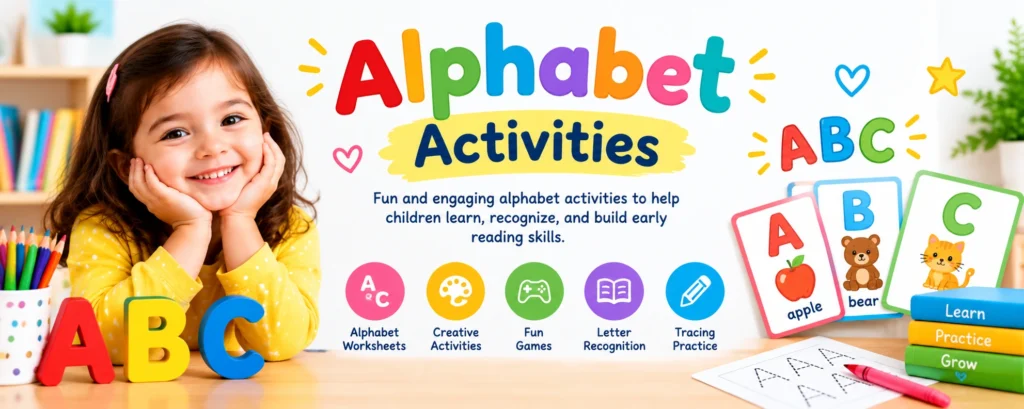
Alphabets Activities help children learn letters in a fun and engaging way while improving their letter recognition, creativity, and early reading skills. Learning Alphabets is one of the important first steps in child early education. Before children can understand words and sentences, they need to recognize letters, learn their sounds and understand how letters make words.
However, learning ABC should not be boring or tough. With simple and fun Alphabet activities children can learn letters during playing, creating, moving and exploring.
ABCs activities are especially useful for preschool and kindergarten children. This can help children to recognize uppercase and lowercase letters, improve sounds of letters, developing writing skills and in making early reading confidence. Parents and teachers can use these activities at home or in the classroom with simple materials that are easy to find.
Learning Alphabets is one of the important first steps in child early education. Before children can understand words and sentences, they need to recognize letters, learn their sounds and understand how letters make words. However, learning ABC should not be boring or tough. With simple and fun Alphabet activities children can learn letters during playing, creating, moving and exploring.
ABCs activities are especially useful for preschool and kindergarten children. This can help children to recognize uppercase and lowercase letters, improve sounds of letters, developing writing skills and in making early reading confidence. Parents and teachers can use these activities at home or in the classroom with simple materials that are easy to find.
What are Alphabets Activities?
Alphabet activities are fun learning exercises which can help children to learn and practice letters of Alphabets. These activities may include letters, gaming, tracing, coloring, matching, singing, crafts, puzzles, and many other hands-on activities.
For example, a child may match the letter A with a picture of an apple or practice writing letter B by tracing the lines. These simple activities make learning interesting and can help children remember letters easily.
Why are Alphabet activities important?
Alphabet activities can support many early learning skills. When children practice letters by different activities, then they get opportunities to see, hear, say, write and use every letter.
Here are some important benefits:
Improving letter recognition
Give children papers with dotted letters. Ask them to draw over the dots with a crayon or pencil.
Start with big capital letters like ( A,B,C,D) because they are easier to draw. Tell them to say the name of the letter while they trace it.
Children need to recognize letters before they can read. Alphabet games and matching activities gave children regular practice with uppercase and lowercase letters.
Build of phonics skills:
Many alphabet activities introduce children to the voice of letters. For example, children can learn that B gives the voice of (b) in words like ball and bat. This helps in preparing them for phonics and reading.
Developing fine motor skills
Tracing, coloring, cutting and writing of letters require children to use hand and fingers movement. These activities can help in making motor skills strong.
Letter cards
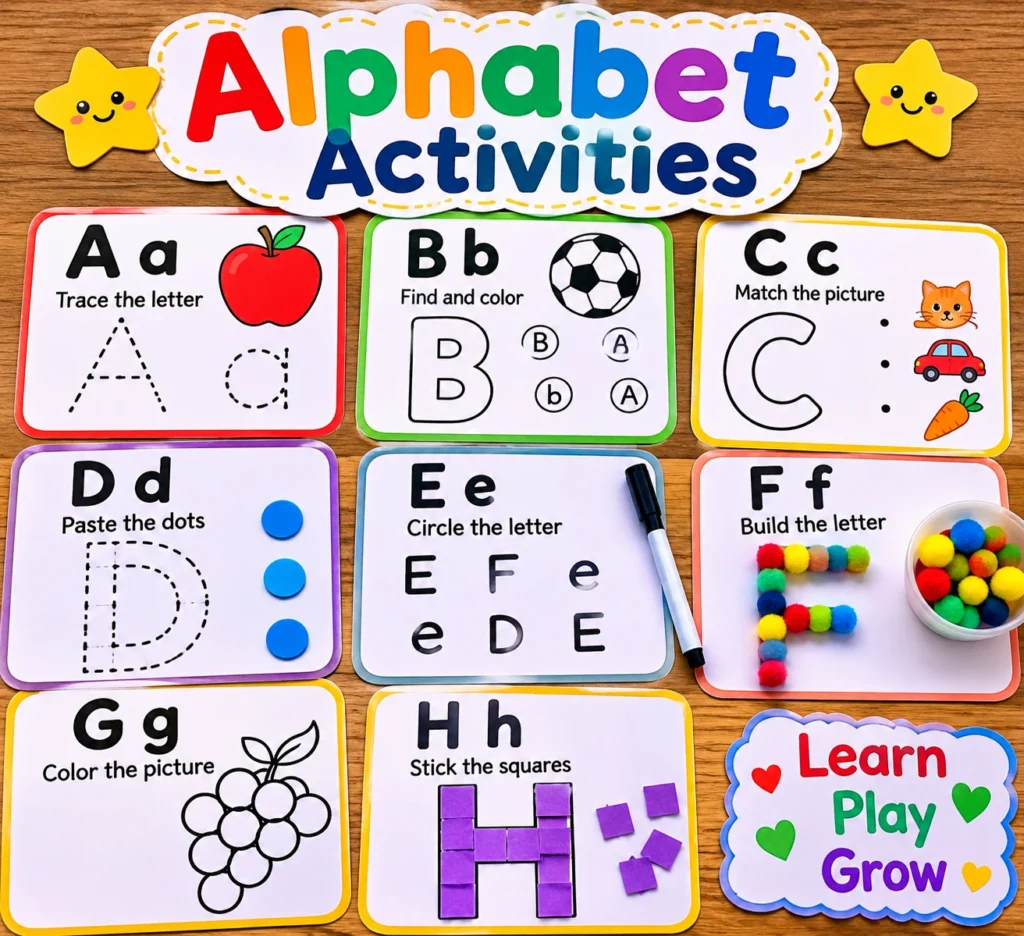
Show your child one letter card at a time. Ask them, “what letter is this?” Use cards with pictures. for example show the letter A with the picture of apple. Mix the card up. Ask the children to find a specific letter like “where the letter B is”? Start just 3 or 4 letters. Add more letters.
Tracing Letter
Give children papers with dotted letters. Ask them to draw over the dots with a crayon or pencil.
Start with big capital letters like ( A,B,C,D) because they are easier to draw. Tell them to say the name of the letter while they trace it.
Coloring Letters
Print out big letters for children to color. Include a simple picture on the page like a big A next to an apple. Children can color the letter and the picture. This helps them to remember the shape of the letter.
Matching game
Make two sets of letter cards. One set has big letters and the other has small letters. Put them on the table. Ask the child to match a big letter with a small letter like A with a. Use only a few letters at the beginning so it is not too hard.
Find the Letters
Choose one letter like B. Ask the child to look around the room and find the things that start with that letter. For B they can find a book, bag or bat.
Playdough Letters
Let children use playdough to make letters. Show them a big letter first so they can copy it. They can roll the playdough like a snake and bend it to make the letter shape.
Letter puzzles
Use a letter puzzle toy where children put the missing letter into the right slots. You can also make a puzzle at home . Write a big letter on cardboard, cut it into two or three pieces ,and ask the child to put pieces back together.
Tips for Teaching the Alphabet
Every child is different, and every child learns at a different speed. So the method of teaching the alphabet should be kept simple and enjoyable so that the child takes interest in learning it.
Keeping the child’s intelligence in mind, instead of teaching the whole alphabet at once, start teaching little by little. This makes learning easier for children.
Children should repeat the letters they have already learned again and again so they don’t forget them, and in this way their practice will also become better.
Children get bored by doing the same work every day, and because of this they cannot focus on learning those things. You can give children tracing practice one day so that their mind stays fresh. In the same way you can also do other activities like making a letter craft and playing a matching game, etc.
Children learn by making mistakes, so when children make a mistake, instead of scolding them, tell them gently. This also increases the children’s confidence and they start learning easily.
When you are teaching children, keep in mind the most important thing – that the activities you are teaching should be short. If the activity you are teaching is long and the child is learning it is small, the child will not be able to maintain his interest in that activity for long, and because of such activities the child also gets bored.
For small children, practice that is five to fifteen minutes long is enough. In this much time, children learn with interest, even if only for a short time.
Conclusion
The best alphabet activities give children many opportunities where they do things like seeing, hearing, speaking, touching, and writing letters. Daily practice and encouraging children instead of scolding them builds writing skills and confidence in children.
It does not matter if you are a parent, tutor, or teacher of the child. You should include the best alphabet activities that take less time in the children’s daily learning routine. You should make sure that the activities are such that children take interest in them. While selecting activities, you should keep in mind whether children are getting bored while learning letters or if their attention is focused somewhere else. By doing all this, children have more chances to learn letters and get an education.