
Effective study habits
Studying for long hours does not always mean you will get good grades. The real secret is studying smarter, staying, focused, and remembering things longer. Good study tips can help many students learn faster and reach their goals. This guide shares simple tips to help you to manage your time, focus better, lower your stress, and get more done.
Why do good study habits matter?
Better understanding: They help you learn hard topics easily and remember them for exams.
Less stress: studying a little bit everyday prevents the stress of last minute cramming.
Better time management: they help you balance your school work with your free time and fun activities.
Builds discipline: you learn how to stay organized and consistent.
Tips: you don’t have to change everything today. Just start with simple changes and slowly build a routine that works best for you.
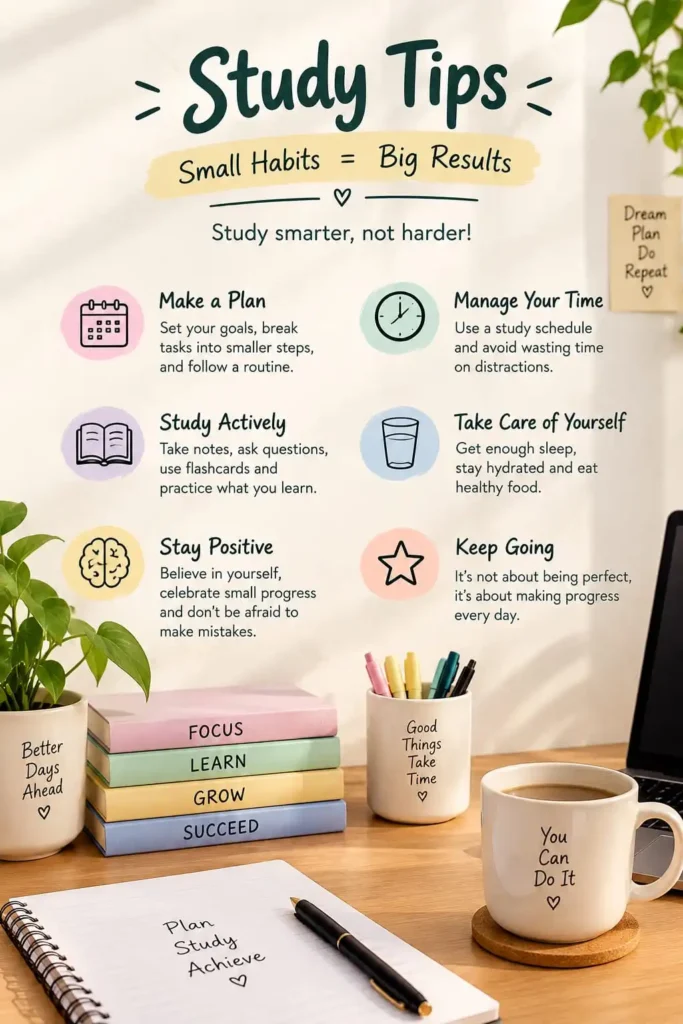
Make a study plan
Write down all your subjects and homework.
Spend more time on hard subjects.
Leave time for review.
Keep the plan easy to follow.
Example: study math for 40 minutes, take a short break then study science for 30 minutes.
Set clear goals
Now what you want to do before you start.
Do not just say” study English.
Stay a clear task ,like “learn 15 new words” and do “two grammar exercises.”
Write down two or three small tasks at the start of your study time.
Pick a quiet place
Find a clear, quiet, and bright place to sit.
Keep your pens, books, and paper close to you.
Clear away toys, phones are messy things from your desk.
Use the same spot everyday so your brain now is time to focus.
Use the pomodoro technique
Pomodoro technique is a specific time management method which divides study into short, focussed sessions.
A simple method work like this
Study for 25 minutes without distractions.
Take a break of 5 minutes.
Repeat this method four times.
Take a longer break of 15-30 minutes.
This method can help you manage your time and secure your mental fatigue. If 25 minutes feel too short or too long then adjust the length of the session according to your need.
Take notes of your own words
Writing notes can help you make information and identify the most important points. However, copying every sentence from the book was not always useful.
Instead, read a part carefully and summarize important ideas in your own words. Use headings, built points, short explanations and examples to make your notes easier to understand.
When you need to revise a chapter quickly before an exam then good organized notes are especially helpful.
Practice active recall
Active recall is a study method in which you try to remember information without looking at your notes or book.
After reading a topic, close your book and ask questions from yourself about what you have learned. You can also use flashcards or write everything you remember about a subject.
For example:
After studying the water cycle, explain its main points without looking at your notes.
Instead of reading it simply, this method encourages you to take information from your memory.
Review chapters regularly
Reviewing information at many times can help you remember it for a long time. This method is called spaced repetition.
Instead of reading a point at once , revise it after one day, a few days and a week. Adjusting the time intervals depends on how you remember the material.
Regular revision is especially useful for subjects that need to memorize definitions, formulas, vocabulary and history dates.
Avoid doing many works during study
Checking messages, watching videos and switching between different works can interrupt your concentration. Smaller interruptions can make it harder to come back to your work.
Put your phone on silent mode and keep it away from your study place. Close unnecessary browser tabs and do one work at a time.
If you need your phone for study purposes, use it only for resources related to your current lesson.
Understand concepts instead of memorize everything
Memorizing has its place in learning but understanding concepts helps you apply knowledge in different situations.
When you face a difficult topic, ask yourself how it works and how it connects to something you have already known. Find such examples which help you in understanding concepts.
You can also understand the topic aloud as you were teaching it to another student. If you struggle to explain an important point, review that point again.
Practice with Questions and Past papers
Practice questions help you see your understanding and identify areas which need improvement. They also give you a chance to understand the questions you may face in exams.
After completing a chapter, solve exercises without checking the answers quickly. If past papers are available, use them to practice for timed conditions.
Review your mistakes carefully. Understanding why the answer is wrong may be more useful than simply memorizing the correct answer.
Take Short Breaks
Studying for hours makes you very tired and your focus becomes less. If you study with small breaks, your mind gets rest and you feel fresh again, and studying becomes easy.
During a break, move your body, drink water, walk a little, or do some other small activity. If you use mobile or talk to someone during the break, avoid those things that change your 5-minute break into 1 hour.
The purpose of this short break is only that when you sit again to study, you feel fresh.
Get Enough Sleep
Sleep is very important for focus, memory, and learning. When you stay awake the whole night for an exam, you don’t complete your sleep, your mind becomes tired and it becomes difficult to remember your lesson.
When you are living a student life, make a fixed time for sleeping and waking up, and give yourself good time for rest so you feel fresh. Normally young people need 8 to 10 hours of sleep daily, while adults need 7 to 9 hours. When a student sleeps well, his health is also good.
It is better to keep a balance between study and sleep, instead of sacrificing sleep for more study. Give proper time to both sleep and study.
Eat Healthy Food and Drink Water for Good Health
Your body needs good food and water to work properly and to study all day. Good and balanced food and water keeps your health better during studies. If you don’t eat good food and water properly, you can get different diseases, and your studies will also be affected.
Eat different types of foods that make your body strong, like fruits, vegetables, grains, protein and best healthy fats. And when you sit to study, keep water with you, so when you feel thirsty you can drink.
To make your health good and make beneficial habits, you don’t need expensive supplements, foods and drinks. Simple and balanced food also makes your body strong, and regular use of balanced foods and water is enough to make your health good.
Frequently Asked Questions about Study Tips
Conclusion
If you develop effective habits that help you succeed so, you don’t need to study for hours. With the right approach, your focus will improve, difficult subjects will become easy, and exam preparation will be better. And there will be no mental pressure on you.
Make a good timetable, try to remember by using your mind, and start with good habits like studying with short breaks.
Remember, studying for a long time or in confusion is not good. Studying for a short time but with full heart and focus is more important.